About

Forest Digital Twin Component (DTC) is funded by the European Space Agency (ESA) as part of ESA’s contribution to the Destination Earth (DestinE) that is a flagship initiative of the European Commission. Further reading on the connection between the Forest DTC, ESA DTE programme and Destination Earth can be found here.

Forest digital twin: integrating data, models and scenarios

A forest digital twin complements existing monitoring by providing a unified, harmonised framework.

  • Existing forest monitoring systems already provide strong foundations, but they address specific scales, methods or national contexts.
  • A digital twin of the Earth’s forests is not intended to replace national forest inventories; it is designed to complement them by offering broader context, harmonisation and scenario-based insights.
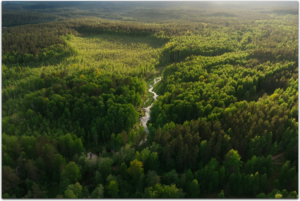
 

A forest digital twin integrates diverse datasets and predicts forest trajectories across multiple scenarios.

  • A forest digital twin brings together currently scattered forest datasets and enables users to integrate their own data – optionally sharing it to support collaborative analysis.
  • A unique feature of the forest digital twin is its ability to predict forest growth and development under different scenarios, such as varying climate, management and human pressure.

 

Showcasing the potential of Earth Observation

Forest DTC leverages the latest Earth Observation (EO) technologies to enhance the digital reconstruction of global forests.

Forest DTC pursues the goal of maximising the potential of the latest advances in EO capabilities to provide an advanced reconstruction of the present and potential future evolution of the world’s forests. The project will deliver an independent thematic pre-operational end-to-end system, including implementation, validation and demonstration through four distinct use cases in varying forest ecosystems.

Forest DTC will use DestinE weather and climate data to quantify forest productivity and fluxes of energy and key chemical constituents from existing and future EO data. To achieve this level of reconstruction at a resolution relevant to forest users and decision‑makers, Forest DTC will include physical models, AI-based emulators and processing subsystems for EO and forest data, as well as the relevant interfaces connecting Forest DTC with DestinE and EO data, various forest parameter maps, forest information and visualisation tools.

The system will enable analysis of what-if scenarios using the latest observations and Climate DT‑based future projections, helping users understand how climate variations and forest management policy decisions affect the well-being and carbon stock of global forests.

Forest DTC is designed with the goal of integrating into the DestinE Platform (DESP) as part of the broader DestinE framework.

Forest Digital Twin Component

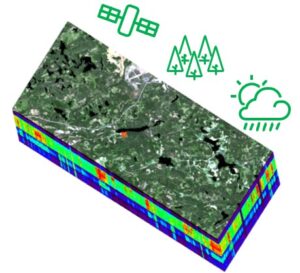
Framework containing process-based forest models initialised with forest data and EO data.

Aligning with the objectives of DestinE, Forest DTC aims to provide DestinE users with tailored information, services, models, scenarios, forecasts and visualisations. The initial state of forests will be retrieved from EO data and forest maps will be updated with the most recent EO data to account for possible disturbances.

Forest DTC will provide a comprehensive description of the forest subsystem, including structural and productivity-related information. Additionally, estimates of carbon fluxes will be generated using meteorological data provided by the Digital Twin of Climate Change Adaptation.

Input data

Satellite, forest and weather data

  • optical multispectral satellite data: Sentinel-2 MSI products
  • forest field data and national forestry databases
  • weather data and different climate scenarios
  • maximising the use of ready-made forest maps
  • updating and enhancing existing maps with EO data
  • new data (such as single tree detection)
  • meteorological data provided by the Digital Twin of Climate Change Adaptation
 

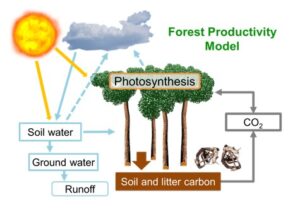
Process-based forest models

PRELES (light use efficiency model)

  • inputs: solar radiation, temperature, VPD, precipitation, LAI
  • outputs: GPP, ET, NEE, etc.

CROBAS (tree growth model)

  • inputs: stand variables (height, diameter, density, species)
  • outputs: stand variables, biomasses, litterfall, etc.

YASSO15 (soil carbon model)

  • inputs: litterfall, woody debris
  • outputs: soil carbon, heterotrophic respiration

3-PGmix (forest growth model)

Products and output data

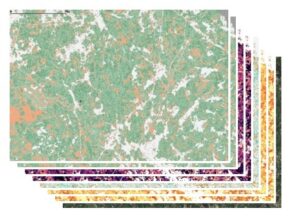
Yearly maps

  • tree species
  • tree height (m)
  • stem diameter (cm)
  • stem basal area (m2/ha)
  • stem volume (m3/ha)
  • annual stem volume increment (m3/ha/a)
  • aboveground wood biomass (t/ha)
  • belowground biomass (t/ha)
  • carbon in woody biomass (tCO2eq/ha)
  • gross primary production (tCO2eq/ha/a)
  • net primary production (tCO2eq/ha/a)
  • evapotranspiration (mm/a)

At very high resolution (10–20 m)

  • to be used for downstream models and use cases
Additional model components and extensions

Forest DTC will include components for forest map update, forest management, forest fire fuel and pest damage risk. The system will be modular, allowing the integration of user‑ or biome‑specific growth models, management simulators and other end‑user extensions.

Demonstration use cases

Although designed as a global tool, the Forest DTC will initially focus on forests in Europe, laying the groundwork for the broader application of forest digital twin worldwide. Four demonstration use cases will be developed across Europe within the project framework:

  1. Assessment of forest biotic disturbances, such as bark beetle outbreaks, in Czechia,
  2. Evaluation of fire fuel and hazards in Catalonia,
  3. Impact of forest management on forest resources and carbon balance in Finland,
  4. Monitoring and modelling for forests using tree-level information across a gradient from tropical to continental forests around the flux towers of the ICOS network.
Scroll to Top