Driven by four distinct Use Cases across diverse forest ecosystems in Europe, Forest DTC has developed a pre-operational, end-to-end system for implementation, validation and demonstration.
The Use Cases are as follows:
- Czechia – Forest development, management and bark beetle infestation risk assessment.
- Catalonia – Forest development and fire hazard assessment.
- Finland – Forest development, management and carbon balance under different management scenarios.
- Science – Advanced forest measurements and their potential for supporting forest growth modelling.
Why were these Use Cases selected?
The four Use Cases were selected to cover diverse geographic areas in order to demonstrate performance under varying conditions and assess scalability. The first three Use Cases were designed for a broader stakeholder audience. While they are scientifically relevant in terms of forest disturbance modelling and carbon balance studies, they primarily focus on practical applications rather than advancing forest modelling research. To address this, the Science Use Case was introduced to broaden the range of modelling techniques and data sources within Forest DTC.
Moreover, the Use Cases were developed and implemented to meet the specific needs of Forest DTC’s Core Users. These users provided detailed input for their corresponding Use Case, including areas of interest, available input data and requirements for output products. Conclusions drawn from these inputs were incorporated into the Use Case specifications and guided their implementation and validation.
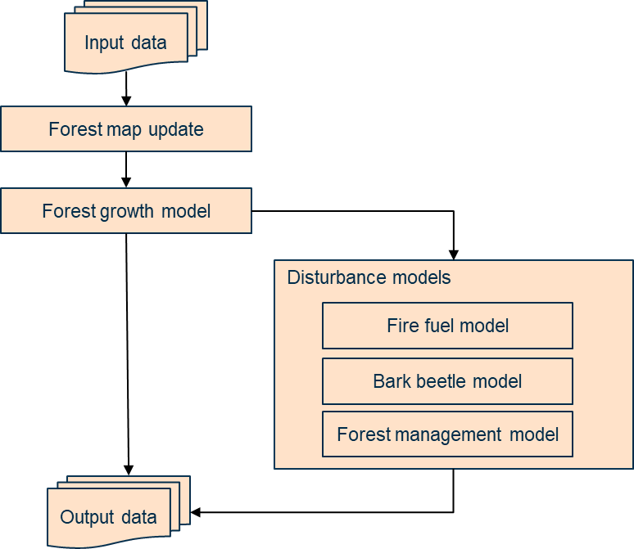
Forest DTC implementation
Forest map update
- In Forest DTC’s map update module, EO data is used to update the available maps to the starting point of simulations.
- The current method is based on computing a change index between growth model outputs and Sentinel‑2 image bands.
- Changed pixels are identified using this index, and for those pixels new values are computed using the k‑nearest neighbours method.
Forest growth models
- Forest DTC aims to quantify how forest growth and carbon balance are influenced by different management and climate scenarios.
- Process-based forest growth models are used to simulate forest development and associated carbon dynamics.
- Forest DTC uses two forest growth models: PREBASSO and 3PGmix.
- These models have been parameterised for various tree species and applied under different environmental conditions. Their applicability depends on suitable input data and model calibration.
Disturbance models
Input data
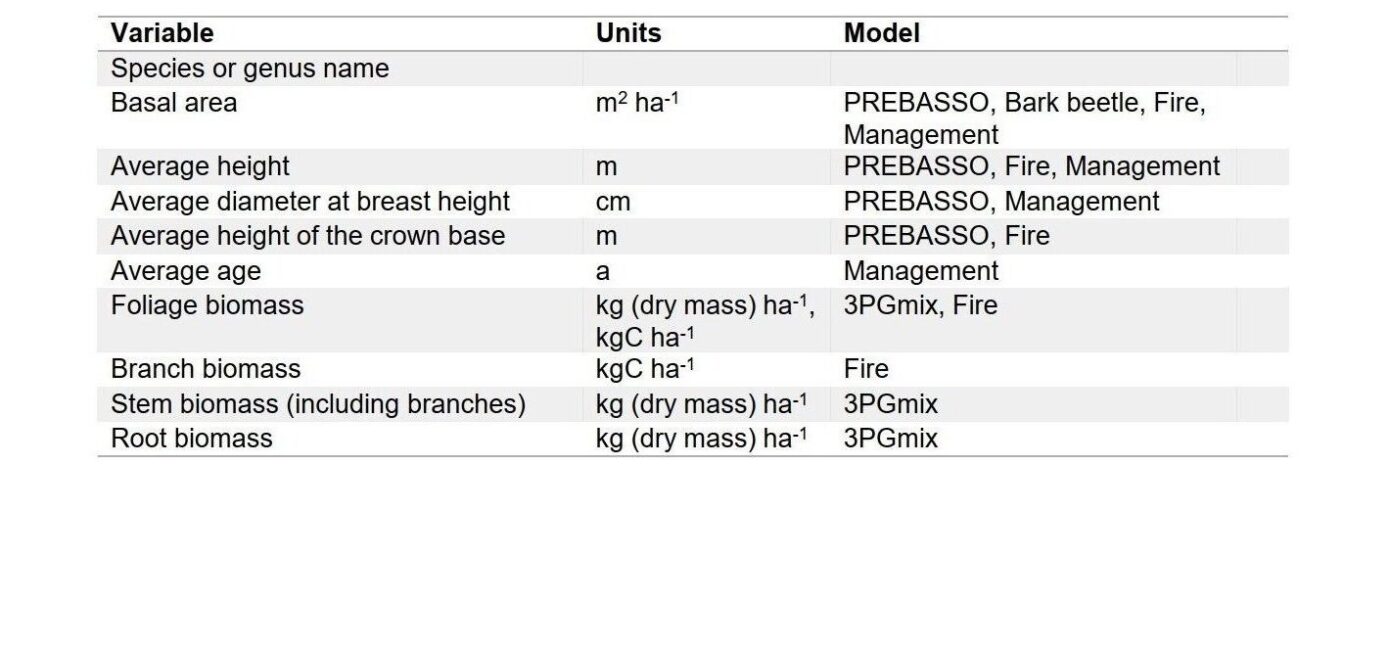
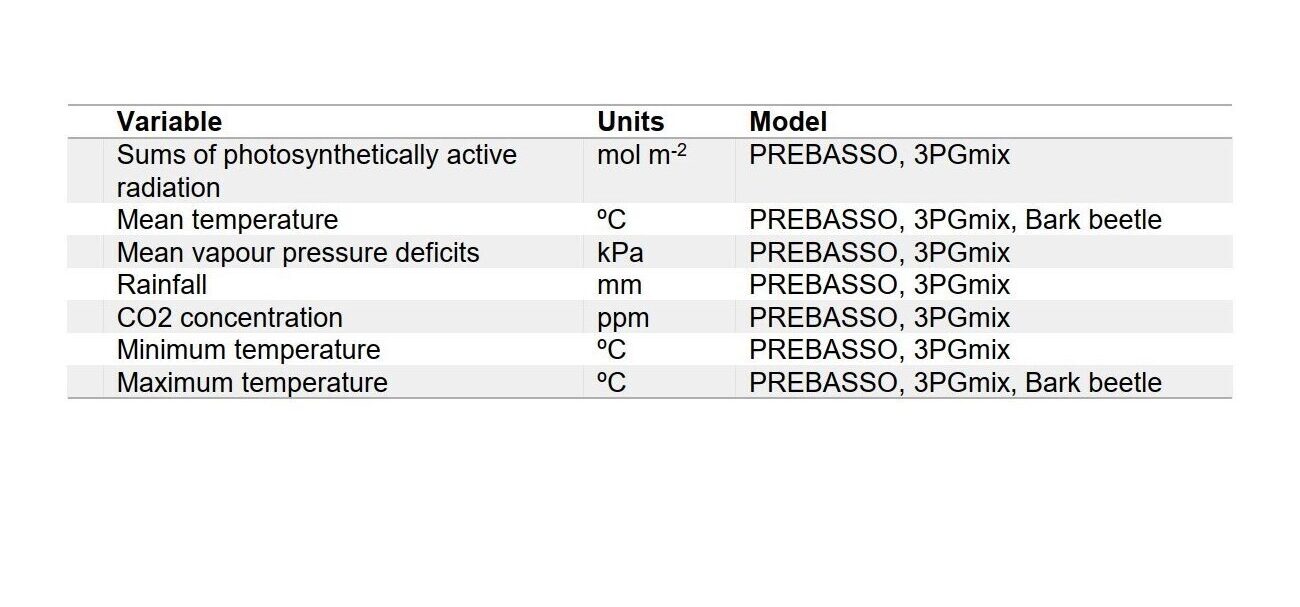
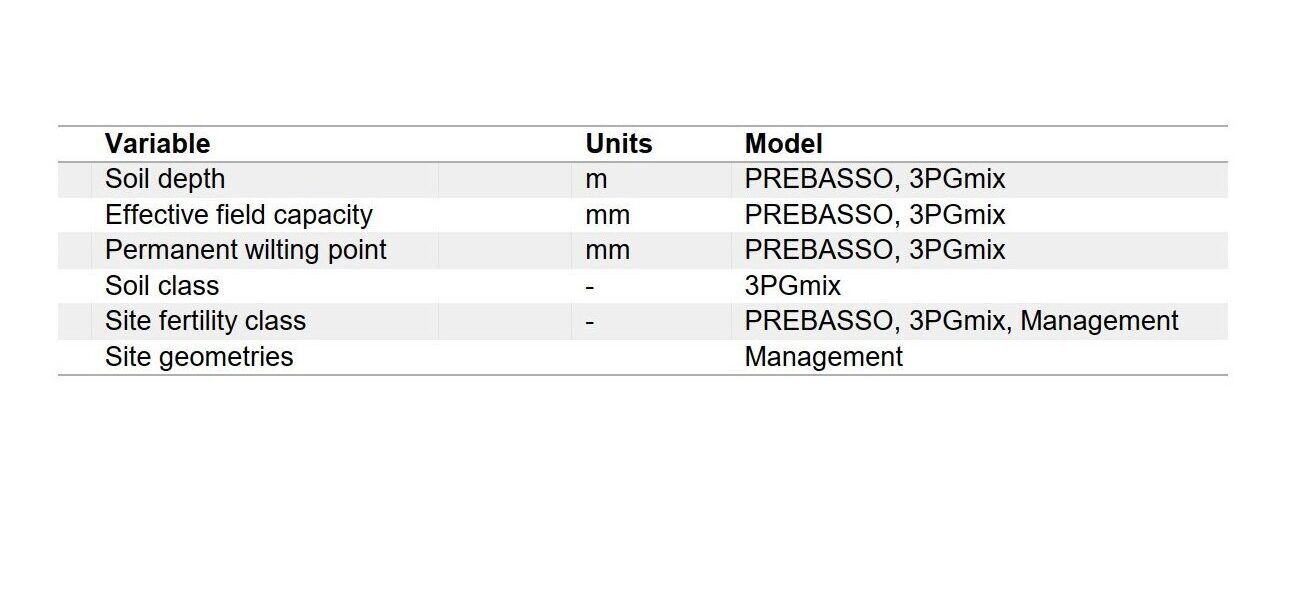
The Forest DTC submodels utilise inputs from the following categories:
- Forest structural variables
- Climate (weather) data
- Site data
Key inputs from these categories are listed below, together with the models where they are applied.
List of the key inputs
Forest structural variables
Climate (weather) data
Site data
Output data
Yearly forest variable and disturbance maps
- Yearly bark beetle risk maps
- Yearly fire risk maps
- Simulated management operations
- Tree species
- Stem volume (m3/ha)
- Basal area (m2/ha)
- Tree height (m)
- Stem diameter (cm)
Yearly carbon and productivity maps
- Aboveground wood biomass (t/ha)
- Belowground biomass (t/ha)
- Carbon in woody biomass (tCO2eq/ha)
- Gross primary production (tCO2eq/ha/a)
- Evapotranspiration (mm/a)
- Net primary production (tCO2eq/ha/a)
- Annual stem volume increment (m3/ha/a)