Forest DTC will be used to forecast forest development in Czechia under various climate scenarios and to assess their vulnerability to bark beetle infestations. The system’s accuracy and its potential for mitigating future risks will be evaluated.
- Core Users: The Czech Forestry Institute CFI and University Forest Enterprise Masaryk Forest in Křtiny (UFE).
- Forest type: Temperate, montane.
- Study area: Area of interest ~50 km by 60 km in Czechia covering forests partly managed by the University Forest Enterprise (UFE).
- Special focus: Bark beetle phenology modelling and growth model validation with dendrometer plots.
Bark beetle phenology model
Background
- Potential development of bark beetle populations will be simulated under various climate scenarios using phenology models calibrated for Czech conditions, such as PHENIPS (Baier et al., 2007; Berec et al., 2013) and RITY-2 (Ogris et al., 2019).
- These models estimate key indicators of bark beetle pressure, including the onset of infestation, timing of completed n-filial or n-sister generations and the annual number of generations.
- Combined with data on forest species composition and age structure, this approach will enable the identification and mapping of potential infestation hotspots in coniferous forests.
Forest DTC implementation
- For the Forest DTC prototype demonstration, the RITY-2 model was selected.
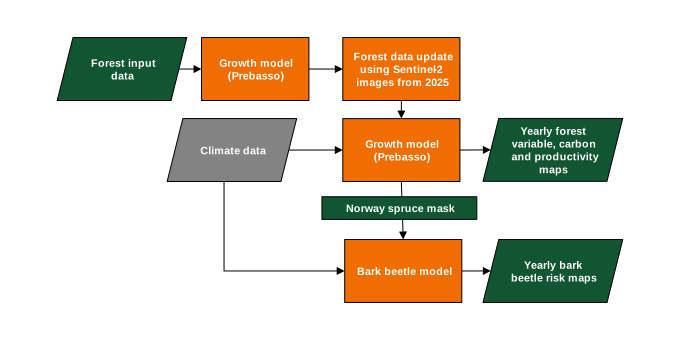
- The model estimates the onset of spring swarming, infestation and the number of generations developed, based on the thermal sum of effective bark temperature.
- Yearly bark beetle infestation risk maps are generated using the estimated number of bark beetle generations per year.
Czechia’s forests under pressure
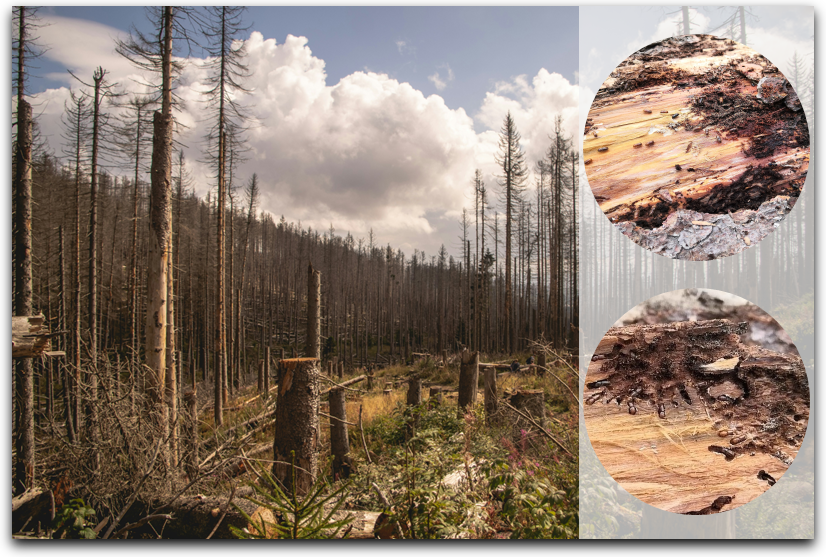
Widespread spruce dieback across Europe – largely driven by the European spruce bark beetle (Ips typographus) – is becoming more common as the climate warms and droughts intensify. These outbreaks cause ecological disruption and timber losses, highlighting the need for more resilient forest management, mixed‑species stands and improved monitoring.
To illustrate how a warming climate is increasing the severity of pest attacks in forests across Europe, we published an engaging visualisation on severe bark beetle outbreaks in Czechia using the DestinE Storytelling Service (DEA). See the DEA story here.